Journal Indicators:
CiteScore 2024 1.0
IF 0.8
H-index 19
SJR 0.265
Points on list of rated journals of the Ministry of Education and Science 40 (punkty z oficjalnej listy Ministerstwa Edukacji i Nauki )

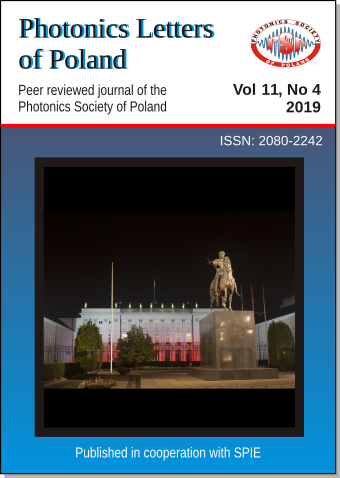
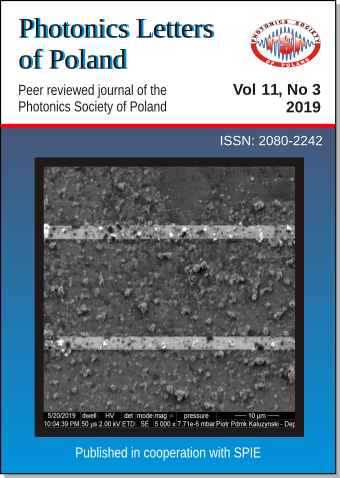
This issue was guest edited by Salvador X. Bara (Universidade de Santiago de Compostela) and Irena Fryc (Bialystok University of Technology).
The current issue of the Photonics Letters of Poland contains ten papers that describe many different aspects at photonics. There are papers about: Photometry and Multispectral Estimation (Univ. Santiago de Compostela, Univ. Murcia, Univ Complutense de Madrid), Entropy and Transmision (Univ. Estadual de Goiás, Univ. Paulista, Univ. Federal da Paraíba, Univ. Federal de Goiás), different Aspects of Light Pollution (Bialystok Univ. of Technology, Warsaw Univ. of technology and Lodz Univ. of Technology), Measurements of Sky Brightness (Krakow Univ. of Technology), Fiber Lasers (Military Univ. of Technol.), Conductive Polymers (Silesian Univ. of Technol.), and 3D Printing (Gdansk Univ. of Technol.). The papers give a flavor of selected research activities of Photonics Society of Poland Board members and their collaborators.
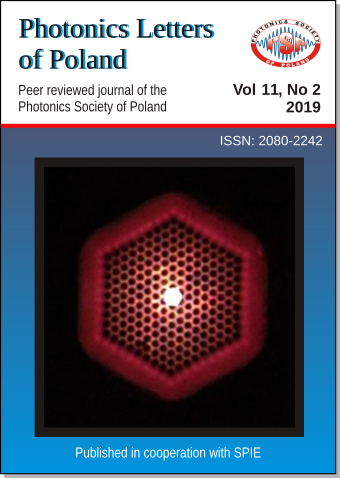
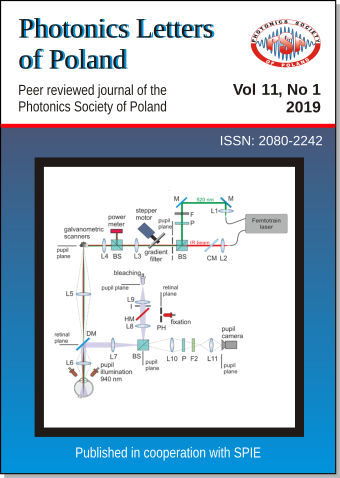
"Liquid Crystals for Photonics" - editorial note by Tomasz R. Woliński, Warsaw University of Technology, Faculty of Physics, Warsaw, Poland
7th International Workshop on Liquid Crystals for Photonics (WLCP-2018, wlcp2018.pl) was held in Jastrzębia Góra, Poland from September 17 to September 21, 2018 in the “Primavera” hotel at a beautiful Polish Baltic Sea shore, 70 km north of Gdańsk – the place where “Solidarity” movement was born in 1980 – and it gathered around 80 participants from Poland, Spain, Slovenia, Belgium, France, Germany, Italy, USA, Japan, Israel, Qatar, Russia, (16 countries in total).
The purpose of the Workshop was to provide a forum for liquid crystal (LC) scientists, researchers, and engineers from all over the world to present their pioneering work on recent progress in LC research for photonics and to exchange their ideas. The discussions provided a state-of-the-art overview of the area, highlighting the latest advances and possible future directions.
The Workshop scientific program included 4 tutorials and 4 keynote plenary lectures given by leading scientists working on liquid crystal photonics as well 6 invited talks and 32 oral contributions to enable stimulating discussions among researchers working in LC materials and devices for photonics.
Excellent plenary presentations: on phase separation in liquid crystals by Prof. Jan Lagerwall (Luxembourg), on electro-optics of oblique helicoidal cholesterics by Prof. Oleg Lavrentowich (USA), on complex liquid crystal geometries created by periodic photo-alignment by Prof. Kristiaan Neyts (Belgium), and on LC light modulators for non-display applications by Prof. Norbert Freuehauf (Germany) was delivered during the Workshop. Prof. L-C Chien (USA) outlined in his invited presentation augmenting light-cholesteric interactions with polymer-stabilized conical helix. Prof. J. M. Oton (Spain) was talking about modulating transmission of waveguides with tunable cladding. Prof. M. Karpierz (Poland) reviewed nonlinear guided light beams in LC structures; Prof. W. Królikowski (Australia/Qatar) devoted his talk to frustrated achiral and chiral nematics with potential for photonics while Dr. E. Oton’s (Spain/Poland) presentation was devoted to blue phase layers as 3D photonic crystals.
The sponsors of the event were Polish Academy of Sciences, Military University of Technology, Warsaw University of Technology, and Photonics Society of Poland, who has distinguished best students presentations of the Workshop: Inge Nys (Belgium, 1 place), Koki Imamura (Japan, 2 place), and Agata Budaszewska (Poland, 3 place).
The current issue of Photonics Letters of Poland contains 9 letters mostly based on the ideas presented during the 7th International Workshop on Liquid Crystals for Photonics.
Journal Indicators:
CiteScore 2024 1.0
IF 0.8
H-index 19
SJR 0.265
Points on list of rated journals of the Ministry of Education and Science 40 (punkty z oficjalnej listy Ministerstwa Edukacji i Nauki )